
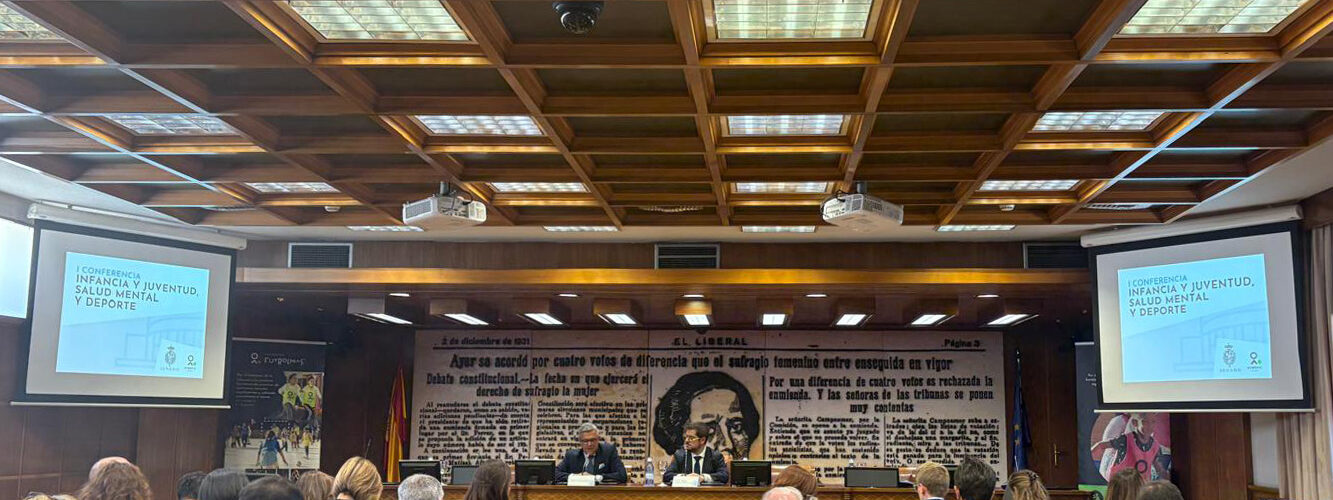
THE RAFA NADAL FOUNDATION PRESENT AT THE 1ST CONFERENCE ON CHILDHOOD AND YOUTH, MENTAL HEALTH AND SPORTS

On Monday, March 31, 2025, the Fundación Fútbol Más España organized the 1st Conference on Childhood and Youth, Mental Health and Sports at the Senate Palace in Madrid.
This pioneering event brought together experts in mental health, sport, education, and childhood to analyze the role of sport in the emotional wellbeing of children and youth.
The Rafa Nadal Foundation was represented by Eunate Gómez, Project Manager, who attended the conference to reinforce the Foundation’s commitment to promoting sport as a tool for personal and social development.
The Foundation’s presence at this event reaffirms its commitment to using sport as a driver for personal development and emotional wellbeing in childhood and youth.
Participation in events like this allows the sharing of experiences, discovering innovative initiatives, and further advancing programs that promote mental health through sport.
The event’s program included various roundtables and workshops that addressed challenges and opportunities in the field of mental health and sport.
The opening ceremony was led by Javier Ignacio Velasco, Ambassador of Chile to Spain, and Gonzalo García Casamayor, President of Fundación Fútbol Más España, who emphasized the importance of cooperation between sectors to tackle the challenges in child and youth mental health.
Among the speakers were representatives from UNICEF Spain, EDUCO, Confederación SALUD MENTAL ESPAÑA, Gipuzkoa Football Federation, and the University of Seville, among others. Additionally, the results of the Gurea Geroa project were presented, and the Icehearts workshop was held, focusing on sport as a tool for promoting mental health in childhood and youth.
In the first roundtable, moderated by Celia Domínguez (Fútbol Más España), concerning data on youth mental health:
• 43% of Spanish youth between the ages of 16 and 29 have been diagnosed with mental health issues.
• In vulnerable situations, this percentage rises to 53%.
• More than 40% of surveyed young people had not shared their distress with anyone, reflecting the stigma surrounding mental health.
In this context, Elisenda González (EDUCO) stressed the importance of ensuring safe environments for children and the need to train professionals in early intervention and prevention.
The second roundtable, moderated by Juan Araya (Fútbol Más Europa), analyzed how sport can be both a tool for wellbeing and an environment of pressure and emotional stress, depending on its management and the surrounding dynamics.
• Iñaki Alonso (KUNINA Sports) warned that sport is not automatically a safe space and emphasized the need to create real support environments.
• Manuel Díaz (Gipuzkoa Football Federation) denounced the lack of commitment to women’s sports in Spain and the need to promote equal opportunities.
• Patricia García (PGR ONG) focused on the lack of women in leadership positions within Spanish sport.
• Nel A. González (Confederación Salud Mental España) insisted on the need to introduce a comprehensive mental health education curriculum in schools.
“Our women’s sport is a giant with feet of clay: no matter how many world championships we win, inequality still marks the reality of football in Spain,” said Manuel Díaz.
In the final roundtable, the ICEHEARTS model was presented, a European Commission-funded initiative that adapts a Finnish mentoring and sport program to promote emotional wellbeing for children in Spain. Diego López (Real Betis Foundation) explained how football becomes a vehicle to convey values like resilience, sportsmanship, and inclusion. Alison Maassen (EuroHealthNet) highlighted the importance of sharing good practices in mental health across Europe.
“We can only be catalysts for joint action if we have actions to share; our job is to connect, spread, and ensure that best practices have a real impact in Europe,” stated Maassen.
The day concluded with an institutional closing by Sira Rego, Minister of Youth and Childhood, who emphasized the importance of continuing to work on public policies that integrate sport into mental health strategies. She stressed the need for a structural and collective approach to mental health and highlighted the role of youth in raising awareness of this issue.
“Emotional wellbeing is a right, not a luxury, and sport is a way to guarantee it,” stated the Minister.

The 1st Conference on Childhood and Youth, Mental Health and Sport made it clear that mental health is a shared responsibility. From institutions to communities, the wellbeing of childhood and youth requires a structural and preventive approach, where sport plays a key role.